Argentine ants (Linepithema humile) dominate the urban soil profile across Los Angeles County, forming multi-queen supercolonies that treat entire neighborhoods as a continuous nest network. Standard over-the-counter…
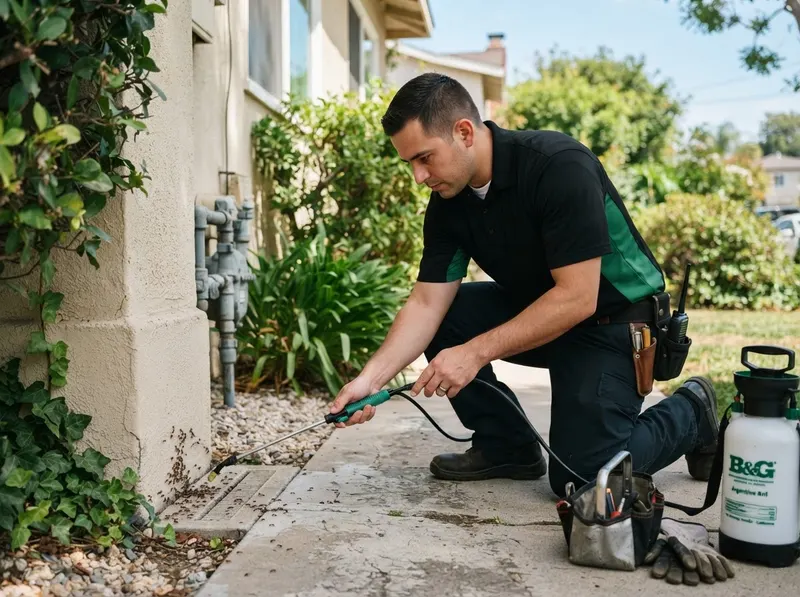
Argentine ants (Linepithema humile) dominate the urban soil profile across Los Angeles County, forming multi-queen supercolonies that treat entire neighborhoods as a continuous nest network. Standard over-the-counter contact pyrethroid sprays trigger an evolutionary defense mechanism known as budding: when worker ants die immediately from contact toxins, the surviving queens split and establish multiple separate satellite nests inside wall voids, plumbing chases, and subflooring. In hillside and canyon zones like Los Feliz, Silver Lake, and Echo Park, dry summer heat and hillside irrigation drives billions of workers directly toward indoor kitchen sinks and pet bowls. In coastal environments such as Venice and Pacific Palisades, moist subsoil layers support massive subterranean populations that enter structures through microscopic slab cracks, foundation vents, and electrical conduits. Effective eradication stops reliance on instant-kill surface toxins and instead applies slow-acting micro-gel baits alongside non-detectable liquid transfers along structural perimeters. These formulations allow forager ants to walk through the active ingredient without detection, carrying the material back to feed reproductive queens, larvae, and colony members over a 7-to-14-day cycle.
Selecting structural eradication over routine surface spraying depends on the biological layout of the property. For a single minor trailing incident along a patio slab, exterior landscape perimeter adjustments and targeted granular baiting stabilize the exterior baseline. For active multi-room indoor trailing across hardwood flooring, kitchen counters, and sub-slab heating ducts, common in older single-family properties in Highland Park, Brentwood, and Sherman Oaks, full-property structural intervention becomes necessary. The trade-off between slow-transfer baiting and immediate topical sprays centers on speed versus biological resolution: direct knockdowns yield immediate dead surface workers within 15 minutes but leave the egg-laying queens entirely viable beneath the foundation, whereas non-repellent structural treatments require 3 to 10 days to achieve full colony collapse but prevent recursive nest splitting. In multi-unit developments and commercial retail structures through Koreatown and Boyle Heights, localized baiting fails if exterior property perimeters remain untreated, as interconnected colony trails travel under municipal sidewalks and shared fences.
1. Initial assessment identifies trail origins, irrigation leaks, and structural weep-hole entries along the structural base.
2. Non-repellent liquid barriers are applied 3 feet up the external foundation wall and 3 feet out onto surrounding soil.
3. Micro-gel bait matrices are injected inside concealed wall cavities, sub-cabinet plumbing penetrations, and dead spaces inaccessible to children and domestic pets.
4. Exterior landscape beds adjacent to structures receive specialized low-dose granular attractants that intercept foraging columns before they approach the slab.
5. Property managers and residents observe a 2-hour drying interval before re-entering treated exterior perimeters, with follow-up inspection checks scheduled at the 14-day mark to verify complete trail cessation.
Every job gets a firm, written price after a free on-site visit.
Tell us about your argentine ant eradication job in Los Angeles and we'll send a clear, written quote, usually the same day.
 Windmill Pest Control